
The innovative Fi negotiation approach


Learn how to negotiate using an innovative approach and share this knowledge with your team. It is guaranteed to help your business grow.
Recently, I delivered a negotiation training program at Nova SBE for executives from different companies and asked whether they had any negotiation experience. Some answered no, while others said yes. Among the latter, one man said he was married. Everyone laughed, and I pointed out that this illustrates perfectly how everyone has negotiation experience, even if they do not use a structured approach.
Negotiation takes place in many situations in business context, for example the acquisition and sale of companies, the purchase and sale of products or services, annual budgeting, project execution, establishing partnerships, strategic planning, recruitment, and career advancement.
It also takes place in personal context, for example raising children, dating, marriage, friendship, and neighboring.
And it also occurs in the wider community, for example legislation, and territorial control.
There is one element common to all these situations: their purpose is cooperation. Viewing negotiation as a threat is a mistake. Negotiation is not a battle. It is a dialogue aimed at achieving cooperation. In other words, it is an opportunity to establish or strengthen a relationship.
For this reason, using a structured approach is essential to achieving successful negotiation outcomes.
The Fi Negotiation Approach Framework
The Fi Negotiation Approach is innovative because it brings together all the essential elements required for successful negotiations within a single structured framework.

The 10 elements of the Fi Negotiation Approach are grouped into object and execution.
To describe the Fi Negotiation Approach, I will focus exclusively on the business context and on the purchase and sale of a solution to a business problem between two companies. However, the concepts apply equally well to all contexts and situations, including those involving multiple parties.
Object
The object consists of the 5 elements that define what is being negotiated.

Scope
Scope defines the boundaries of what is being negotiated. Initially, the scope is the solution to the business problem. During the negotiation, the scope may be expanded to address additional business problems or narrowed to focus only on the most important issues. For example, if the business problem is managing client relationships during the sales process, the solution may be a CRM system for the sales department. However, the business problem may be expanded to include client relationship management during service delivery, in which case the solution becomes a CRM system covering both the sales and client service functions.
Some time ago, I presented a proposal for a company growth program in which the main deliverable was a plan of initiatives designed to support the company's growth. The CEO of the company told me that he would accept the proposal only if I included support for implementing the initiatives as well as training for his team. As a result, the scope of the engagement was expanded.
The scope is never closed until it is closed.
Value
Value is the benefit for each party.
Before reading the next paragraph, take a minute to think about what you would do if you won €100 million in the EuroMillions lottery.
When people are asked this question, their answers usually include buying things (such as a house, a car, or clothes), travelling, investing, starting a business, celebrating with friends, giving part of the money to family and friends, supporting charitable causes, establishing a philanthropic foundation, and many other initiatives.
This shows that people are motivated by three different spheres of motivation:
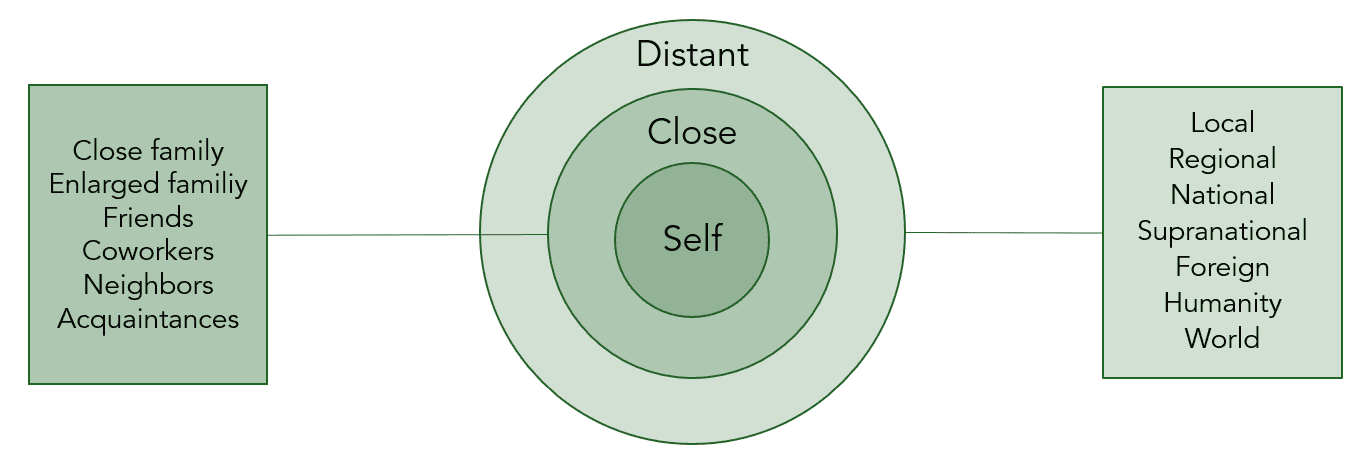
The self sphere is usually the strongest, but the close sphere and the distant sphere also play an important role in decision making. For example, many brands highlight the environmental sustainability of their products.
Before reading the next paragraph, take a minute to think about how many people are involved in a negotiation between two companies when each company is represented by a single individual.
If your answer was two, you missed. In reality, there are four. This is a point that is often overlooked, even by highly experienced negotiators. The four parties involved are the representative of company 1, company 1, the representative of company 2, and company 2.
In a negotiation, individuals are driven by both corporate motivations and personal motivations, which guide them in seeking benefits for their company as well as for themselves. These benefits fall into three categories: functional, emotional, and economic.
From the perspective of a buyer seeking a solution to a business problem, the motivations associated with value can be illustrated in the following table:
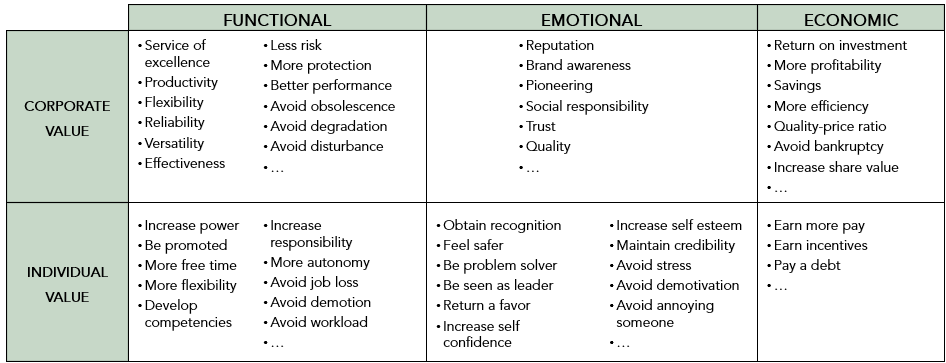
Keeping this in mind is essential for achieving successful negotiation outcomes. As Zig Ziglar famously said, people are always tuned in to the WIIFM radio station (What's In It For Me?).
Value represents the desired output of the negotiation.
Price
Price is what each party must offer to reach an agreement.
In a negotiation, individuals are motivated to secure the best possible price for their company. Like value, price has three dimensions: functional, emotional, and economic.
From the buyer's perspective, the motivations associated with price can be illustrated in the following table (in this context, the individual's personal price is not relevant, although it may be relevant in other contexts):

Price represents the input required to complete the negotiation.
Throughout my professional career, I have encountered countless cases of buying organizations that focus exclusively on price while ignoring value. In practice, they are commoditizing their suppliers' businesses, overlooking the fact that suppliers are business partners. Many suppliers go along with this approach.
Alternatives
Alternatives are the courses of action available to each party if no agreement is reached.
It is essential to identify the available alternatives and determine the best one, commonly known as the BATNA (Best Alternative To a Negotiated Agreement), in case the negotiation does not end successfully.
We should never begin a negotiation without an alternative. In other words, we should always have the option to walk away. Otherwise, the other party may take advantage of your position and secure an agreement that is unfavorable to us.
Conversely, we should also avoid taking excessive advantage of a situation in which the other party has no viable alternative. Although this may produce significant short-term gains, it is likely to result in future retaliation because the relationship between the parties will have been damaged.
There may be exceptions when we believe there is no possibility of ever dealing with the other party again. However, life has many twists and turns...
Recently, I presented a proposal to a company to develop a growth strategy for one of its business units. I explained and quantified the value the company could expect from the project, supporting my assessment with market data and my firm's previous experience in similar engagements. In response, the company stated that, before accepting the proposal, it needed a list of initiatives proving that the proposed value could be achieved. I explained that producing that list was precisely the outcome of the engagement, but the company remained inflexible and expected the work to be completed before awarding the contract. Fortunately for my firm, we have reasonable clients. Fortunately for the prospective client, the business unit concerned represented only 1% of its overall business. We both had an alternative.
Information
Information is critical to achieving success in a negotiation.
It is impossible for two parties to possess exactly the same information about any given issue. This is known as information asymmetry.
In the context of buying and selling a solution to a business problem between two companies, the table below illustrates the difference in the information available to each party:
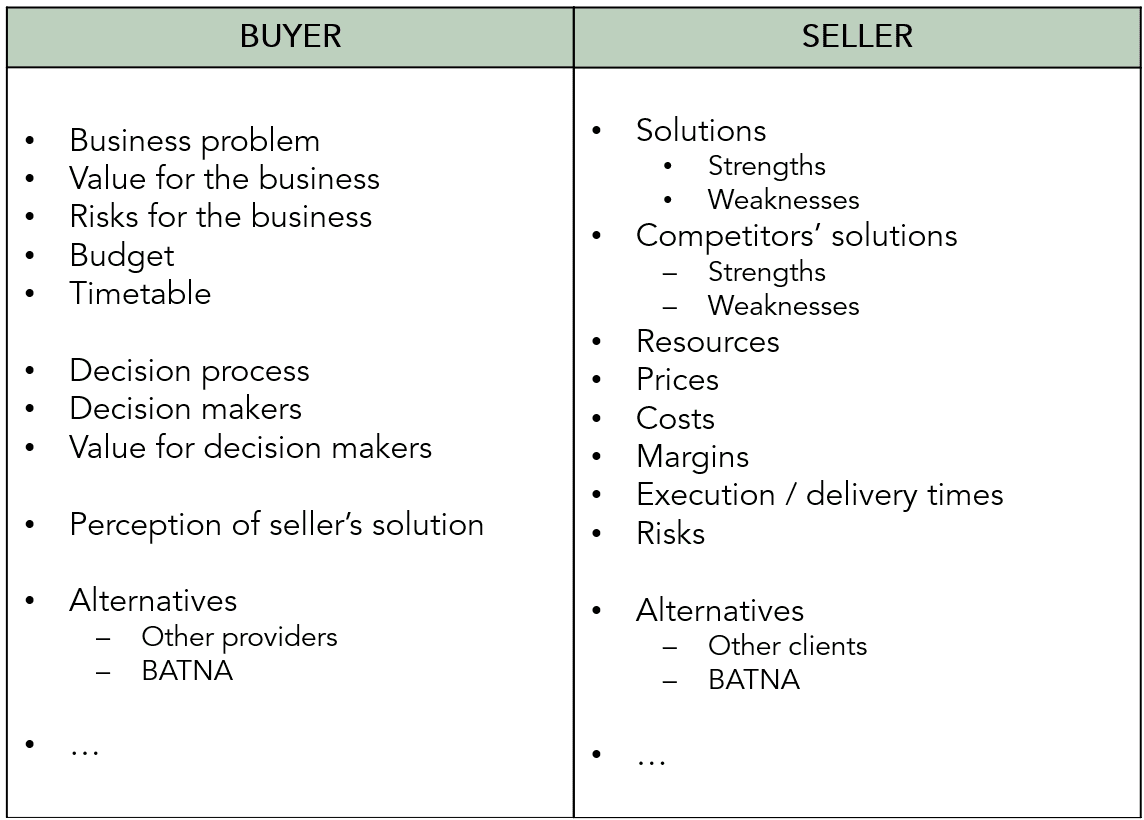
Another point to consider is the legitimacy of information. For both parties to accept a particular piece of information, they must rely on third parties that have no direct interest in the negotiation and are recognized by both sides as impartial and independent. Examples include market research firms, regulatory authorities, statistical agencies, and official publications. Without this foundation, proposals may be viewed as arbitrary by the other party, making it difficult to reach consensus.
A well-known example involves a former Prime Minister of Portugal who purchased an apartment in Lisbon in 2016 at a price below market value, most likely because the very elderly owners were not well informed. He sold the apartment only a few months later, achieving a gain of approximately 82% in less than a year.
When we are not well informed, the other party may take advantage of that situation.
Execution
Execution comprises the 5 elements that govern the interaction between the negotiating parties.

Communication
Communication is the fundamental tool for dialogue in any negotiation.
Without fluid communication, reaching an agreement becomes difficult. When the parties come from different national or cultural backgrounds, communication requires even greater attention.
Communication has three components:
- Verbal: communication should be formal (free of mistakes, diminutives, and slang), constructive (using positive and no confrontational language) and clear (good pronunciation, concise and without unnecessary filler expressions).
- Vocal: the tone, pace, and volume of the voice should be moderate.
- Visual: we must have presence (blend in, standing upright, and friendly posture), dynamics (moderate gestures and appropriate physical distance and touch according to cultural norms) and appropriate eye contact (neither staring nor avoiding eye contact, again in line with cultural norms).
When someone communicates with us and these three components are not aligned, it is difficult to trust what they are saying because we instinctively sense that something is wrong. For example, when someone speaks without looking us in the eye, we often feel that they may not be telling the whole truth.
If this principle applies to how we perceive others, it also applies to how others perceive us. For that reason, we should learn both to interpret and to master all three components of communication.
In international negotiations, professional interpreters should be used whenever the parties are not fluent in the same language.
Time
Time runs before, during, and after a negotiation.
Time is always moving forward and can work to the advantage of the party that is under less pressure to reach an agreement.
Before the negotiation, time is relevant for thorough preparation. We should not rely on divine inspiration to achieve a successful outcome. Instead, we should prepare the 5 elements of the negotiation object, together with some additional aspects that will be discussed later under the tenth element, “Process”.
During the negotiation, time is also relevant because of the different personalities of the people involved and the different cultures of their companies and their countries.
Researcher Michele Gelfand conducted extensive work on the cultures of different countries and concluded that some cultures are tighter, while others are looser. These differences arise from several factors, particularly a country's history of collective threats (social unrest, wars, natural disasters, and famine), and the strength of its institutions (political system, judicial system, legislation, religion, and media). Among the tighter cultures are North Korea, Pakistan, Saudi Arabia, Iran, China, Egypt, South Korea, Japan, Russia, Türkiye, India, and Morocco. Among the looser cultures are The Netherlands, Sweden, Finland, Norway, Australia, USA, Argentina, Canada, United Kingdom, Spain, Germany, and France. Portugal lies somewhere in the middle, being neither particularly tight nor particularly loose.
This is important because tighter cultures generally require more time to negotiate (they prefer to build trust before reaching any agreement). Looser cultures, by contrast, tend to value speed throughout the negotiation process.
Although countries have distinct national cultures, companies often develop organizational cultures that override certain national characteristics. Likewise, individuals have unique personalities that may differ from both their national and organizational cultures in some aspects. It is therefore essential to understand the preferences and expectations of the other party and align them with ours.
Personality has a significant influence on the length of a negotiation. One of the best-known personality classification models is DISC:
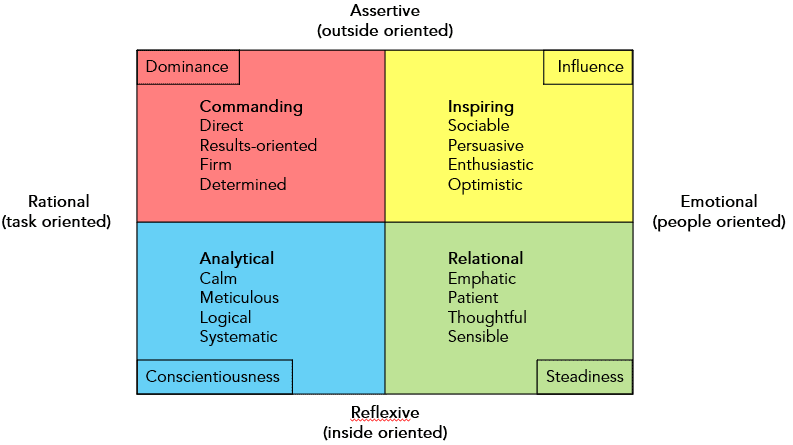
Everyone has characteristics associated with each of the colors in the DISC model, although one color is usually more dominant than the others. Individuals with Red and Yellow profiles tend to make decisions more quickly, whereas those with Green and Blue profiles generally take more time before reaching a decision.
After the negotiation, time is relevant to influence our approach. If the negotiation leads to a long-term relationship, we have a greater incentive to seek mutually beneficial agreements to cease future opportunities. If the negotiation is unlikely to result in an ongoing relationship, we may be tempted to adopt a more aggressive approach. However, as mentioned earlier, life has many twists and turns...
Emotions
Emotions influence the way we act and react.
There are countless emotions. According to the Swiss Center for Affective Sciences at the University of Geneva, emotions can be classified along two dimensions: energy and pleasantness:
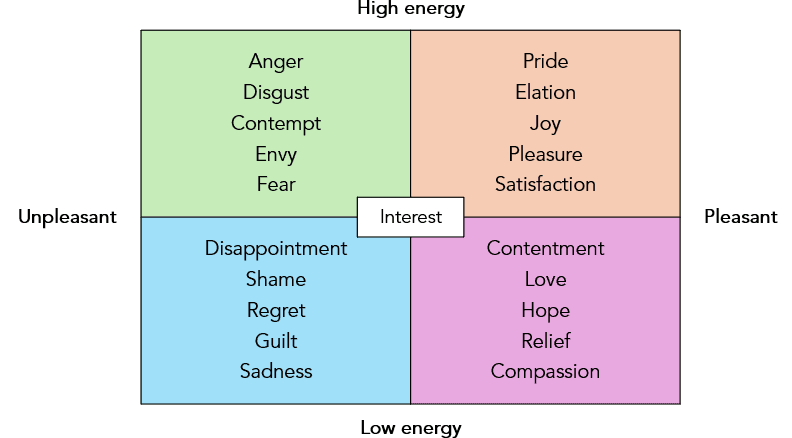
Being excessively influenced by any emotion is detrimental to a negotiation. High energy emotions may cause us to make decisions too quickly and overlook important issues. Low energy emotions may lead us to decide too slowly and miss valuable opportunities. Unpleasant emotions may cause us to reject good proposals, while pleasant emotions may lead us to underestimate risks. The most constructive emotion in a negotiation is Interest, which is emotionally neutral and encourages an open mind and a focus on mutual gains.
It is impossible to eliminate emotions, otherwise we would not be human. When emotions override rational thinking, two situations may arise:
- Moderate influence: We should take advantage of the other party's reduced capacity for rational thinking and persuade them to conclude the agreement.
- Extreme influence: We should avoid allowing the situation to escalate into inflexibility. It is important to recognize the emotional state and manage it appropriately, including taking a break if necessary.
Emotions can often be identified through facial expressions, although some people are trained to conceal them completely through a poker face, and in tighter cultures this behavior may occur naturally. In looser cultures, maintaining a neutral facial expression may help achieve short-term gains, but it can significantly hinder the development of trust and may ultimately prove counterproductive.
Trust
Trust is essential for reaching an agreement.
Building trust in a negotiation requires action in three areas:
- Reliability: being authentic, being transparent, having emotional control, keeping commitments.
- Relationship: affinities, calm voice, open posture, active listening, genuine interest, empathy, and behavioral mimicking.
- Intentionality: knowledge (gained through thorough preparation), mirroring (putting ourselves in the other party's position), open mind, focus on mutual gains, and assertiveness.
Process
Process is the tenth and final element of the Fi Negotiation Approach and brings together all the other elements.
The process consists of 4 Ps.

Preparation includes the following activities:
1. Characterize the object of the negotiation by addressing the first 5 elements described above.
2. Anticipate concessions and exchanges by putting yourself in the other party's position.
3. Anticipate the other party's tactics. If the other party is a buyer, refer to the article "How to react to buyers' negotiation tactics" for a more detailed discussion of buyers' persuasion tactics.
4. Select your persuasion tactics. If the other party is a seller, refer to the article "How to persuade clients to buy" for a more detailed discussion of sellers' persuasion tactics.
5. Identify missing information, carry out additional research, which may include preliminary discussions with the other party and the use of large language models, and then repeat the process from the beginning.
Planning includes the following activities:
1. Define the agenda and the ground rules.
2. Determine the venue or venues and the date or dates.
3. Determine the number of participants to ensure numerical balance and understand their personality profiles so that the most effective arguments can be used:
- Dominance: emphasize results, speed, control, and competitive advantage.
- Influence: emphasize relationships, recognition, enthusiasm, and inspiration.
- Steadiness: emphasize predictability, trust, team harmony, and continuity.
- Conscientiousness: emphasize data and evidence, quality, logic, and risk reduction.
4. Rehearse the negotiation with a member of your team playing the role of the other party.
Performance includes the following activities:
1. Present the object, the agenda, and the ground rules.
2. Make the first offer if you are well informed. Otherwise, wait for the other party to make the first offer.
3. Bargain according to the following guidelines:
- Focus on value by asking questions and understanding the other party's motivations.
- Manage emotions.
- Build trust.
- Show appreciation for the other party's contribution (whenever appropriate).
- Make concessions only when they are matched by reciprocal exchanges.
- Apply persuasion tactics.
- Record progress throughout the negotiation.
4. Close the negotiation by preparing a concise summary of the agreed terms, photographing it, and immediately sharing it with everyone present.
The pact includes the following activities:
- Formalize: draft and sign the agreement.
- Follow through: honor the terms of the agreement with future opportunities in mind.
Conclusion
Everyone has negotiation experience, even if they do not use a structured approach. The framework presented above provides that structure and enables negotiators to maximize the benefits they achieve.
Now that you know how to succeed in negotiations using the innovative Fi Negotiation Approach, deepen both your own knowledge and that of your team. Doing so will undoubtedly help your business grow.
Filipe Simões de Almeida
Managing Partner, Fi Consulting
Published on 7 July 2026